Response
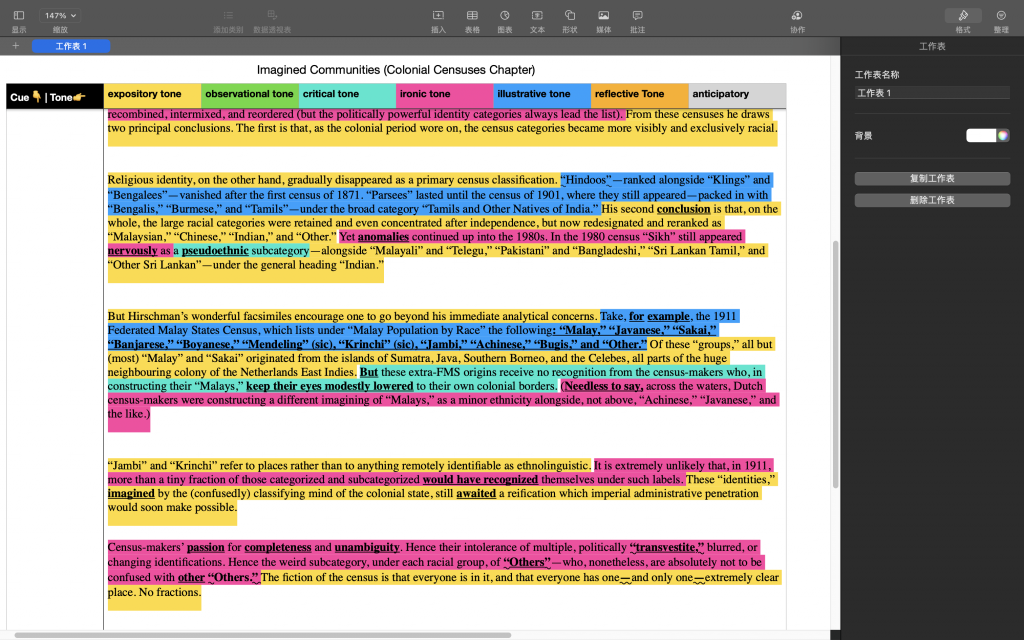
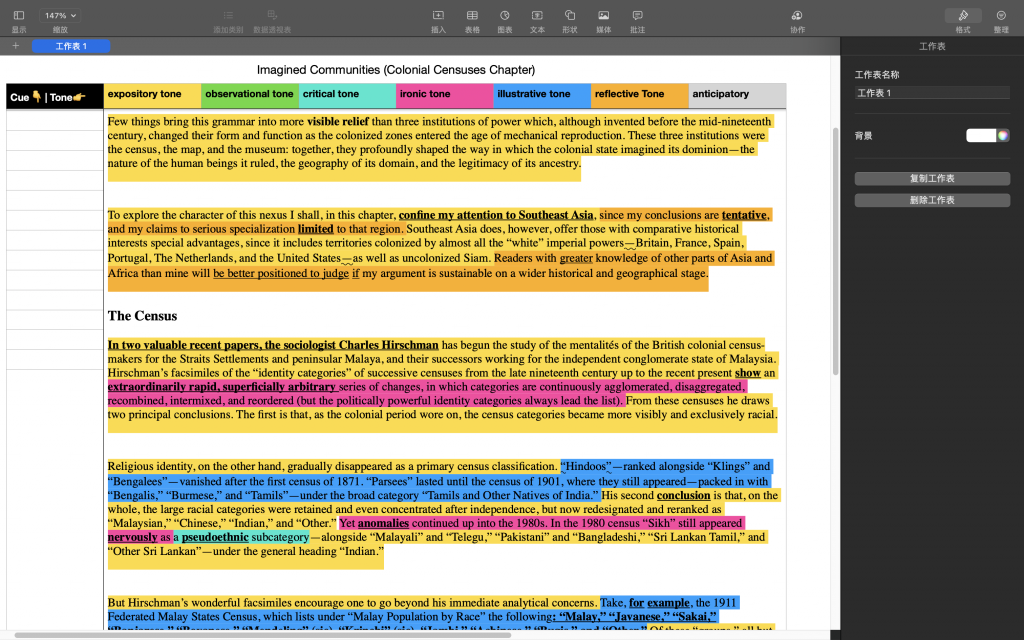
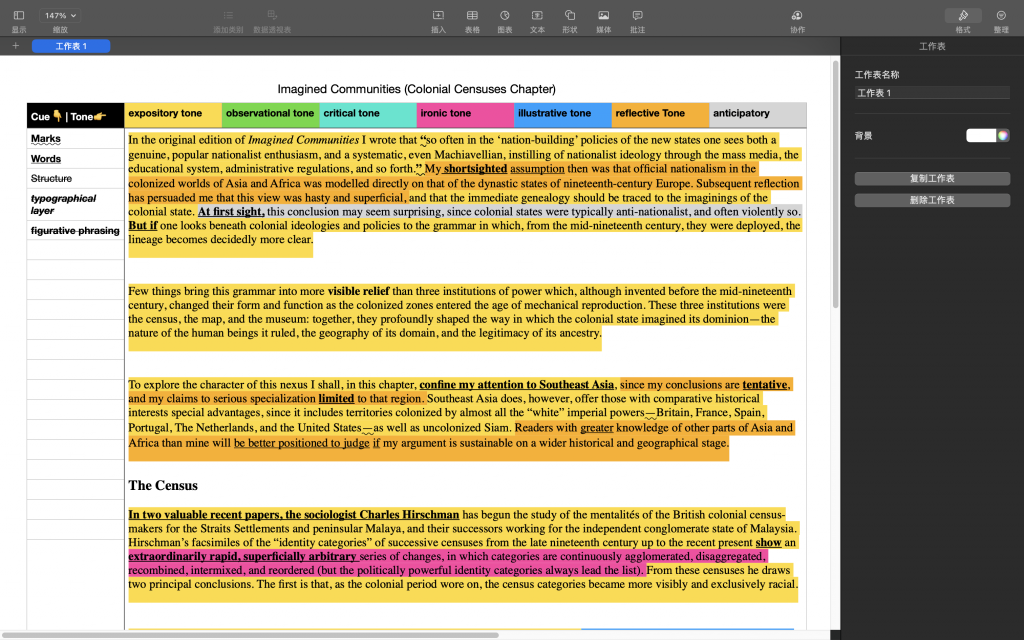
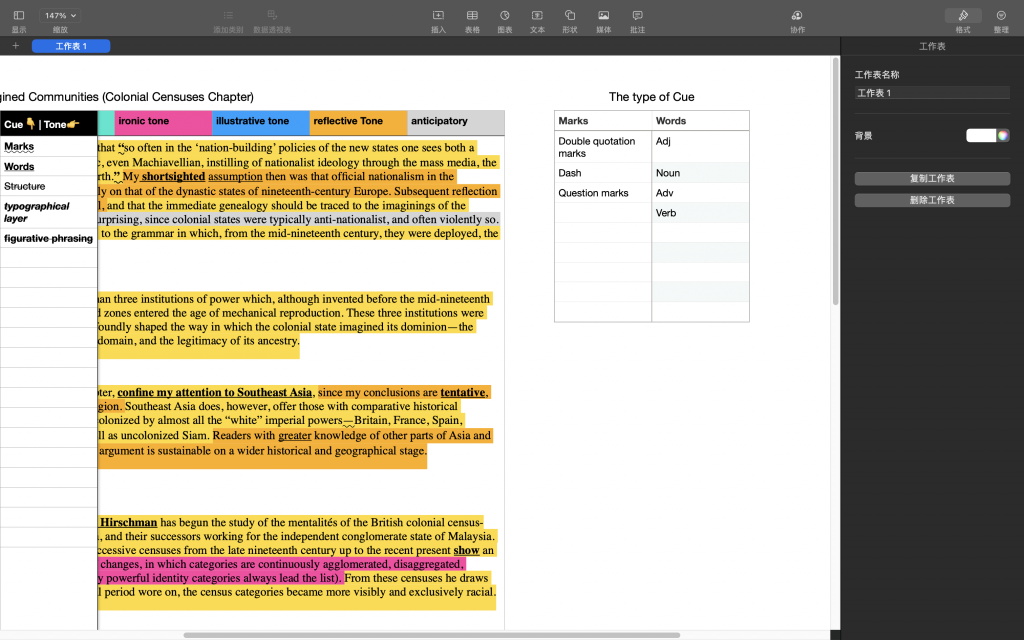
In this prompt, I attempt to construct a “tone inventory” for Benedict Anderson’s Imagined Communities, focusing on his discussion of the “census.” By categorizing sentences according to reflective, explanatory, illustrative, and critical tones—and identifying the linguistic markers that reinforce these modes, such as the ironic use of quotation marks or the rhetorically charged word “transvestite”—I aim to explore how Anderson’s linguistic tone and textual form participate in the production of knowledge itself as a means of understanding colonial power.
In the introductory section, Anderson’s tone is primarily explanatory—measured, detached, and seemingly objective—as he lays out the theoretical foundation. However, as his argument shifts toward specific examples, the tone transitions into one that is critical and ironic. This irony often emerges through the estranging function of quotation marks or certain lexical choices, prompting readers to recognize that what appears as objective description in fact conceals a layer of critique. For me, this approach is more persuasive than straightforward exemplification, as irony generates a reverse argumentative force.
During my preliminary analysis, I attempted to include rhetorical structure as part of the tonal framework. Yet I later realized that rhetoric is not an external device but an intrinsic quality of language itself—a single word or sign can already perform rhetorical work. The term “transvestite”, for instance, simultaneously operates as metaphor and critique, embodying irony in both form and content.
I believe that fragmenting the text’s tone and structure in this way allowed me to see more clearly the reflective process and the composure required in academic writing, while also acknowledging the presence of a subtle, restrained humor within it. The balance between these tones—where irony and critique serve as secondary layers, and rational exposition and illustration remain central—makes the argument more persuasive and the overall context more coherent.
reference
Benedict Anderson, ‘Census, Map, Museum’, Imagined Communities, 2006
Leave a Reply