Studio work
10_31_presentation
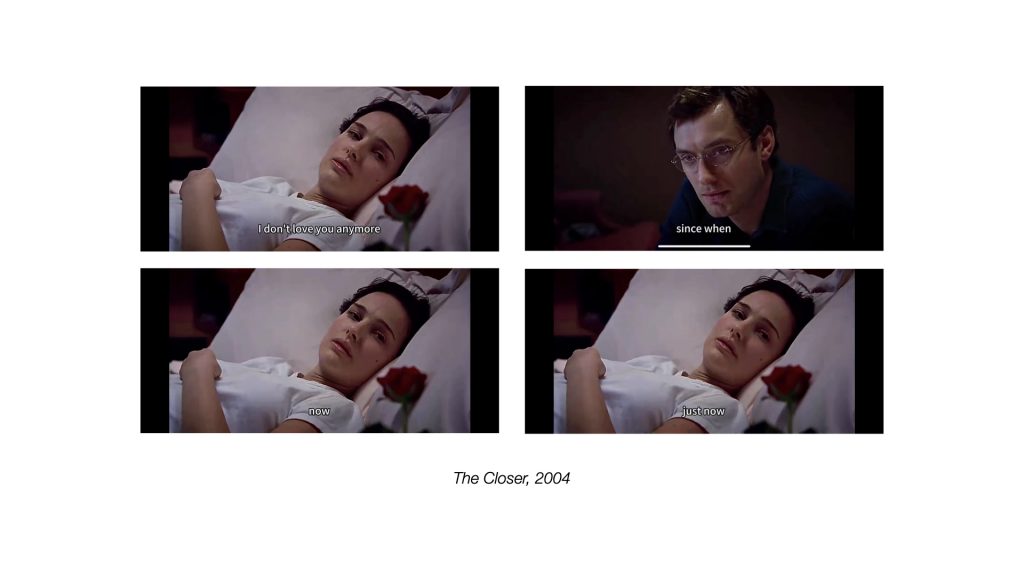
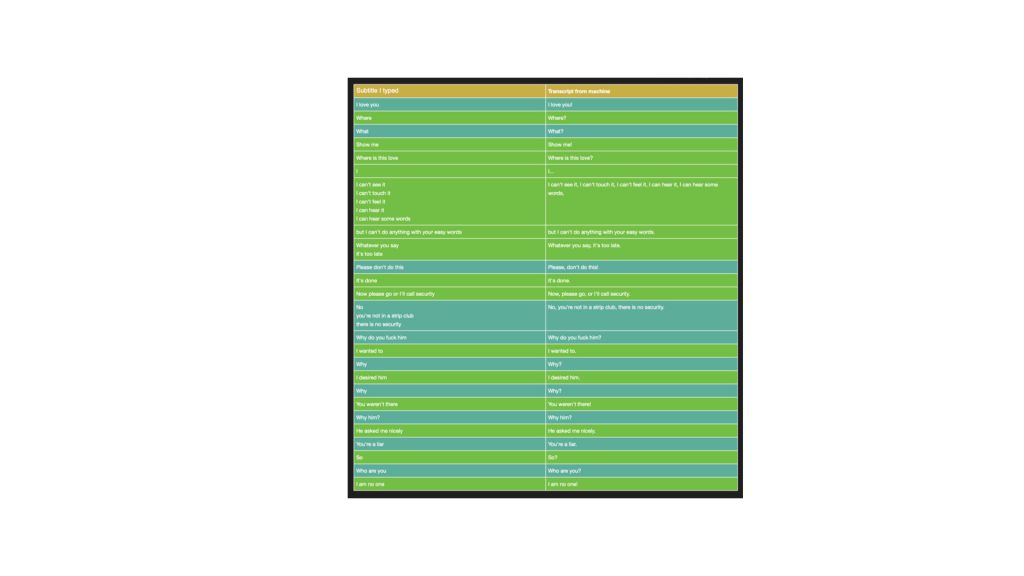
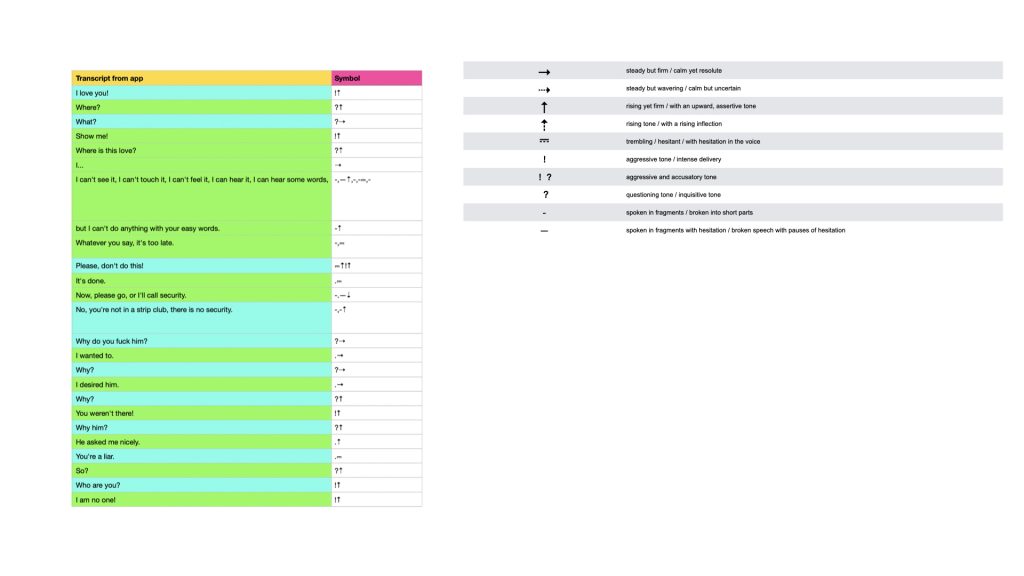
I chose four different ways to translate the same piece of dialogue.
The first way was to use directional symbols to simulate the tone and rhythm of spoken language—trying to express the emotional shifts in the speaker’s voice through the strength, direction, and speed of the symbols.
The second way was to translate emotions directly through emojis. This is an extremely condensed form of emotional expression, where all the complex feelings are forced into a single simple icon.
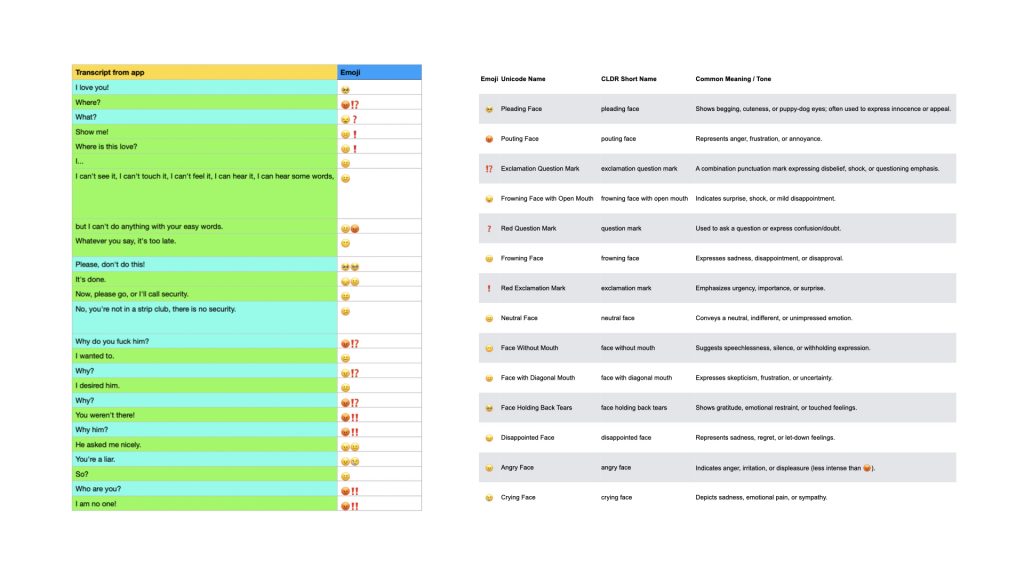
The third way was to let AI handle the translation. This required me to first become the listener—to sense the tone and emotions, and then summarize them into text. But during this process of “textualization,” I felt that many emotions were lost. It was like doing subtraction: I diluted the original emotional intensity before handing it to the AI, and then the AI performed its own arithmetic, generating a dialogue that looked the same but was fundamentally different.
original version
2 versions of transcribe with description of emotion
-Version 1
Liam
[emotional] I love you.
Alice
[anger] Where?
Liam
[emotional] What?
Alice
Show me [anger] Where is this love?
I, I can’t see it.
I can’t touch it.
I can’t feel it.
I can hear it.
I can hear some words, but I can’t do anything with your easy words.
[helplessness] Whatever you say. It’s too late. [helplessness]
Liam
[hoplessness] Please don’t do this.
Alice
It’s done. [firm][resigned][exhausted]
Now please go or I’ll call security.
Liam
[defiance] No, you’re not in a strip club. There is no security.
Liam
Why do you fuck him? [anger][furious]
Alice
I wanted to. [indifferent][resolute][provocative]
Liam
[anger] Why?
Alice
I desired him. [indifferent][resolute][provocative]
Liam
Why? [anger][yell]
Alice
You weren’t there! [anger][accusatory]
Liam
Why him? [anger][furious][yell]
Alice
He asked me nicely. [provocation]
Liam
You’re a liar! [heartbreak][sadness]
Alice
So?
Liam
Who are you? [rage][anger]
Alice
I am no one. [anger][yell]
-Version 2
Liam
I love you [emotional]
Alice
Where [query][anger]
Liam
What [doubt]
Alice
Show me [anger] Where is this love?
I, I can’t see it.
I can’t touch it.
I can’t feel it.
I can hear it.
I can hear some words, but I can’t do anything with your easy words.
[helplessness] Whatever you say. It’s too late. [helplessness]
Liam
Please don’t do this [despair][heartbreak][fear]
Alice
It’s done. [firm][resigned][exhausted]
Now please go or I’ll call security.
Liam
[defiance] No, you’re not in a strip club. There is no security.
Liam
Why do you fuck him [anger][furious]
Alice
I wanted to. [indifferent][resolute][provocative]Liam
Why [anger][furious]
Alice
I desired him. [indifferent][resolute][provocative]
Liam
Why [anger][furious]
Alice
You weren’t there. [anger][accusatory]
Liam
Why him? [anger][furious][yell]
Alice
He asked me nicely. [provocation]
Liam
You’re a liar. [heartbreak][sadness]
Alice
So? [mocking calm][defiant sarcasm]
Liam
Who are you [rage][anger]
Alice
I am no one. [anger]
4 versions of Audio(some of them have bug…) translated by AI
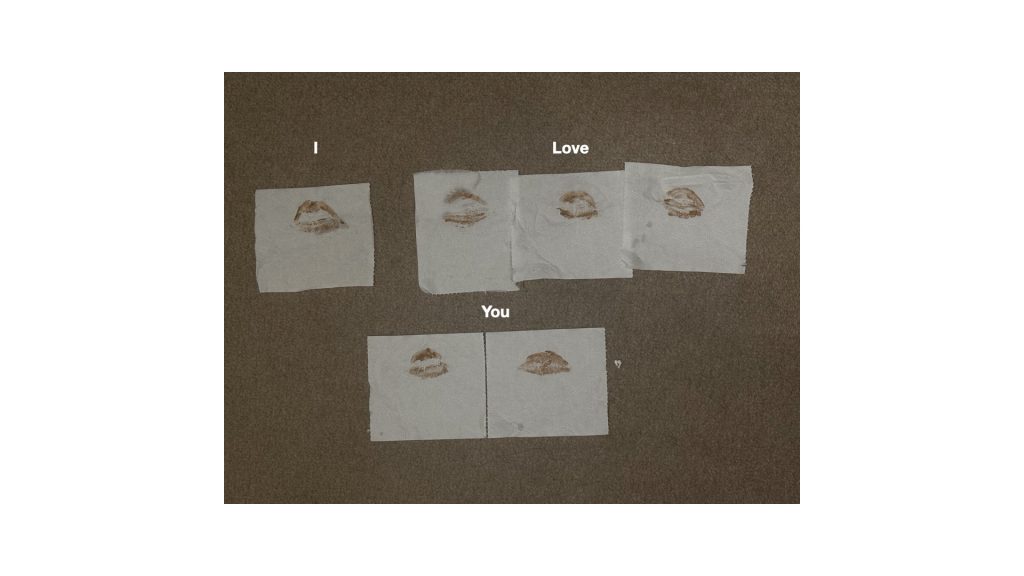
The final method was to translate the content through the shape of the mouth—language completely removed, leaving only the physical motion itself.
Among these four methods, I realized that the act of translation itself is not merely a “representation” of the original, but a continuous creation of new understandings and distortions. As emotions flow through different media, they are constantly reconstructed and reborn.
11_07_presentation
I chose to continue exploring the third approach. In the AI-regenerated dialogue, I tried to reawaken the missing emotions by adding background music—giving the voices a renewed sense of “human presence.”
I created four versions: three with different emotional atmospheres of BGM, and one with only the pure AI dialogue. Then, I invited different listeners to experience all four versions and mark the parts that felt “off” or “distorted.” Through this process, I wanted to observe how a sense of authenticity is constructed when emotions are first translated by AI and then re-supplemented by human-made sound.
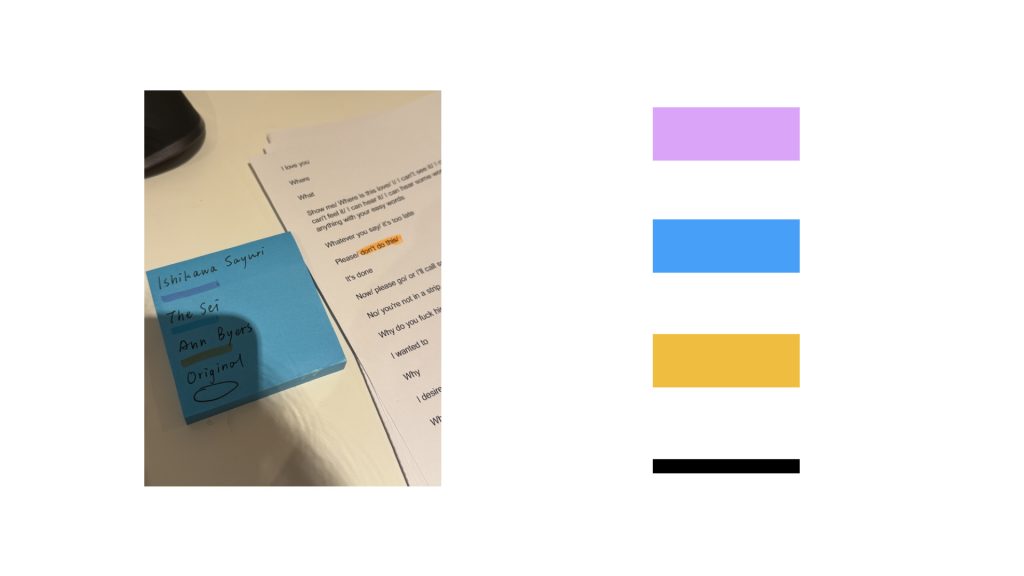
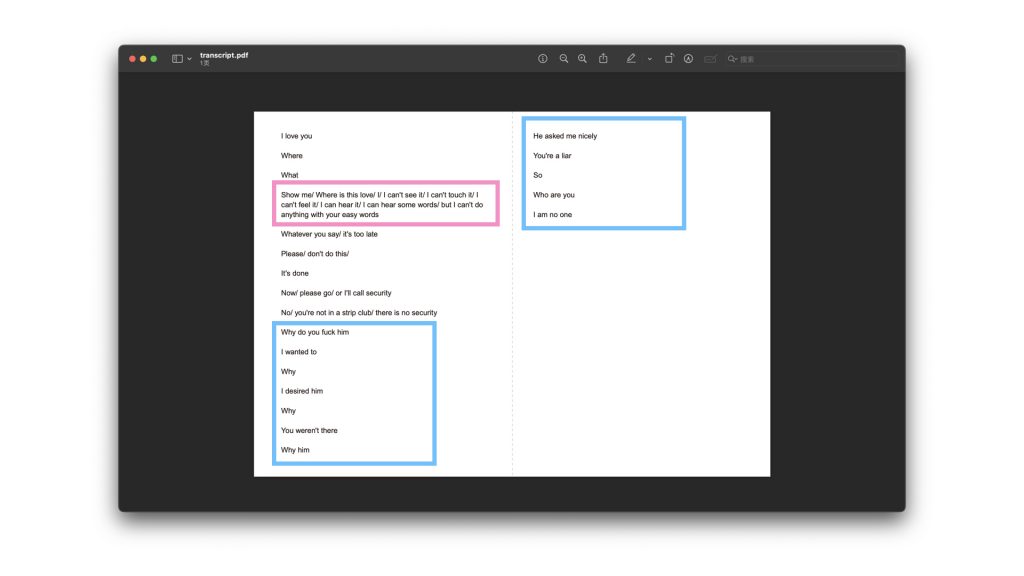
4 versions of audio with different BGM
Ishikawa Sayuri_1
The sei_1
Ann Byers_1
no BGM_1
results of the experiment
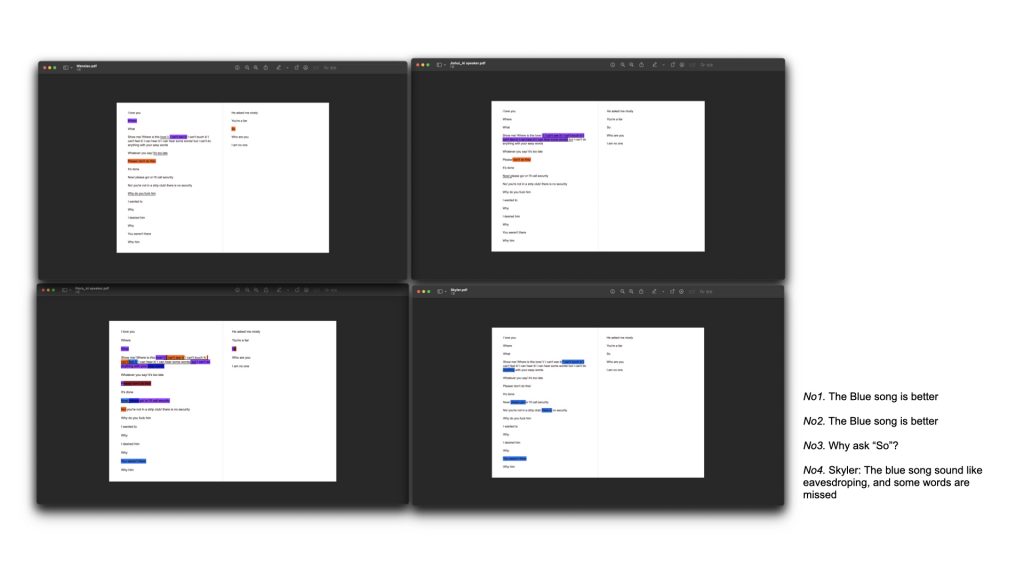
At first, I felt that compared to the original, the AI monologue most obviously lacked the emotional progression—the gradual build-up in the female speaker’s tone leading to the final outburst. However, for listeners who hadn’t heard the original recording, this progression in the quarrel wasn’t something they particularly noticed. What stood out instead was the lack of progression within individual lines.
Based on that, I wondered if music could fill in this missing emotional progression. So, I added a segment of emotionally building sound. I haven’t tested it yet, but when I listened back, it seemed that the absence of emotional progression became less noticeable. It felt as if the missing emotional scent of the AI had dissolved under the influence of music.
Emotion progression with music progression
Reflection
That made me start thinking: in language, how much do the literal content and the number of words matter, compared to the atmosphere of the dialogue—the background music, for example? What actually guides our understanding of a conversation? Is it the linguistic content itself, or the emotional rhetoric we’ve gradually built through different contexts of interaction? If it’s the latter, then besides music, what else could it be? Body language? Eye contact? And if this dialogue were no longer a dialogue at all—but transformed into another medium—would the emotional resonance it conveys still remain the same, or would it deviate?
11_10_Extension
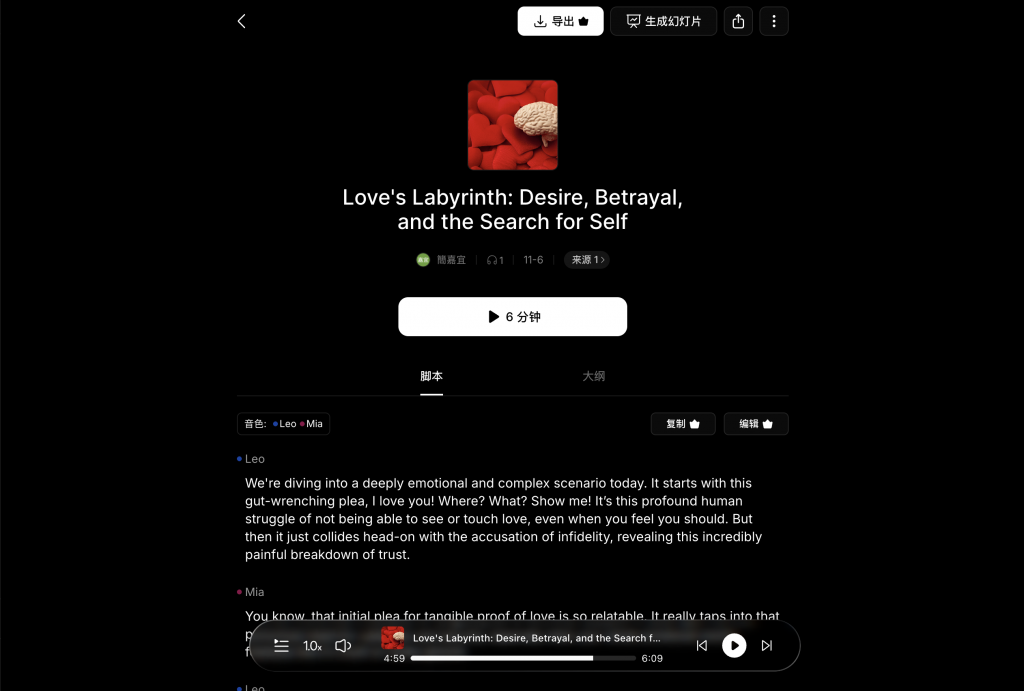
The same piece of dialogue, when translated into different media, always changes in how I receive and interpret it.
In the medium of a podcast, for example, the AI-generated version adds narration and explanatory information. Its analytical quality becomes stronger, while the emotional tension of the original conversation is weakened. It sounds more like an analysis or deconstruction than an emotional exchange.
Broadcast translated by AI
broadcast
Music translated by AI
Style: for running
Style: lo-fi, hip hop, 70 bpm
Conversely, when the same material is used to generate music, the grammar of the medium shifts entirely. When set to “lo-fi, hip hop, 70 bpm,” the work still retains the dialogue—it feels like a conversation accompanied by background music. But when set to “for running,” the music completely detaches from linguistic content, transforming into a pure expression of rhythm and energy.
This made me realize once again: when the same linguistic content is translated across different media, it’s not only the form that changes, but also the way perception and understanding are reconstructed. The medium itself becomes part of the meaning-making process.
Audio Collection
YouTube(Time stamp included):
https://youtu.be/RSWJg-vWqv8?si=pIkzLU3WHRrhZXu3
Google Drive(Spare/Single audio included/no time stamp):
https://drive.google.com/drive/folders/141JVHHiu-u93Ft4Z9tHHAss7wgdfbC5q?usp=sharing
Time Stamp:
00:00 Original Audio
00:50 Process of Translating in AI — Version 1
01:46 Process of Translating in AI — Version 2
02:39 Simulated Tone (no BGM)
03:29 Simulated Tone + BGM (Ishikawa 2015)
04:19 Simulated Tone + BGM (Byers 2009)
05:11 Simulated Tone + BGM (The Sei 2018)
06:01 Media Shift Testing — Broadcast
07:32 Music: lo-fi, hip hop, 70 bpm — Version 1
08:29 Music: lo-fi, hip hop, 70 bpm — Version 2
09:47 Music: for running — Version 1
12:25 Music: for running — Version 2
Studio Work reference
Film
Nichols, M. (2004) Closer. Available at: https://www.youtube.com (Accessed: 16 November 2025).
Music (for BGM Experiments)
Ishikawa, S. (2015) ちゃんと言わなきゃ愛さない. ちゃんと言わなきゃ愛さない. Available at: https://www.youtube.com (Accessed: 16 November 2025).
Byers, A. (2009) I’m happy without you. Best Of Lash Records. Available at: https://www.youtube.com (Accessed: 16 November 2025).
The Sei. (2018) Metroma. Metroma. Available at: https://www.youtube.com (Accessed: 16 November 2025).
AI Tools Used
ListenHub (n.d.) ListenHub – AI audio-to-broadcast transformation. Available at: https://listenhub.ai/zh (Accessed: 16 November 2025).
UDIO (n.d.) UDIO – AI music generation platform. Available at: https://www.udio.com (Accessed: 16 November 2025).
Minimax (n.d.) Minimax – AI audio voice recreation. Available at: https://www.minimax.io/audio (Accessed: 16 November 2025).
ElevenLabs (n.d.) ElevenLabs – AI voice and tone synthesis. Available at: https://elevenlabs.io (Accessed: 16 November 2025).
Written Response
This piece re-presents Hito Steyerl’s In Defense of the Poor Image through the multi-style structure of Raymond Queneau’s Exercises in Style.
“The networks in which poor images circulate thus constitute both a platform for a fragile new common interest and a battleground for commercial and national agendas. They contain experimental and artistic material, but also incredible amounts of porn and paranoia. While the territory of poor images allows access to excluded imagery, it is also permeated by the most advanced commodification techniques. While it enables the users’ active participation in the creation and distribution of content, it also drafts them into production. Users become the editors, critics, translators, and (co)authors of poor images.” (Steyerl, 2012)
Poetic Version
A fragile ecology, a silent battlefield—
both are born from the ghosts of these images.
They gather like mountains and rivers converging into a single stream—
at once clear and murky, filthy and pure, elevated and base,
transcendent yet worldly.
The fish drink from the river to quench their thirst,
yet in drinking, they too become part of the river itself.
Brief Style
The benefits brought by poor images are unstable,
forming at once a contested arena for commercial and national agendas.
Their contents are uneven in quality.
For users, poor images ignite creativity—
yet they also absorb that very creativity to reinforce their own system.
Personified Dialogue
- Poor Image:
“My circulation grants you certain benefits, yet it also becomes a stage for the rivalries of commerce and politics.” - Viewer:
“Those benefits you speak of—so fleeting, so uncertain. I haven’t forgotten the vulgarity, the pornography, and the paranoia that fill your veins.” - Poor Image:
“Everything has two faces. Admittedly, I am not pure. But precisely because of that, the experimental and the artistic—those cast out by the mainstream—can find their way through me.” - Viewer:
“I admit, you’ve shown me what I couldn’t otherwise see. But aren’t those revelations merely generated by my own data, calculated and returned to me?” - Poor Image:
“Still, I awaken your creativity. You film, you share, you remake.”
Personified Dialogue (Romantic Dramatic Style)
- Poor Image:
“My flow makes you feel seen, even warmed.
Yet at the same time, I’ve become the stage where power and desire intertwine.” - Viewer:
“The warmth you promise—so fickle, so uneven.
Don’t think I haven’t noticed your impurities:
the vulgar, the obscene, the paranoid—all glowing through your light.” - Poor Image:
“I was never meant to be perfect.
It is through my impurity that the beauty exiled by the world finds shelter within me.” - Viewer:
“Perhaps. You’ve shown me what I could never have seen.
But don’t forget—what you show is drawn from me:
my desires, my clicks, my pauses—they are all the language of your algorithm.” - Poor Image:
“But I’ve changed you too. You film, you write, you cut again.
You’ve gained a larger stage—not only to watch or to click,
but to pour out your inspiration,
to resonate with your own creative soul and your longing to express.
You think it’s for me, but it’s for yourself.” - Viewer:
“No—it’s you who need me.
You feed on my creativity, my comments, my translations, my fervor—
they are the fuel for your system.
We think we’re in love, but in truth, we’re consuming each other.” - Poor Image:
“Isn’t that what love always is?
Between giving and taking—who can ever tell who is using whom?” - Viewer:
“Don’t forget—you also thrive on that creativity. The platform harvests our videos, our comments, our translations, our edits—your very fuel.
We think we are creating, but in truth, we are laboring for you. You absorb our participation, fold it into your system, and turn it into your own productivity.”
Conclusion
Transforming an academic paper into a completely different textual style not only alters the way emotions are conveyed but also clarifies and enriches the internal relationships within the text. In Steyerl’s original writing, the poor image functions as an objective subject, analyzed in terms of its roles and effects across different fields. However, when reinterpreted in the form of a dialogue, the “viewer” — the affected party — becomes clearly defined, and the relational context between the viewer and the poor image becomes more discernible, revealing a dynamic of mutual causality. I believe this approach can also be applied to other subjects mentioned by Steyerl — such as “the battlefield of commercial and national agendas” or “fragile interests” — allowing for a renewed interpretation through such retranslation. This process enables us to grasp more concretely the influence of the poor image across various domains, as well as the broader system in which it operates.
References
Steyerl, H. (2012) In Defense of the Poor Image.
Queneau, R. ([1947] 1998) Exercises in Style.
Leave a Reply