Progress Review Summary
Losing Z
In many dynamic images, rotation is used as a common and intense visual technique. When the subject at the center of vision continues to spin, we tend to perceive this change as a form of “three-dimensional motion.” How, then, is this sense of three-dimensionality formed and judged?
From a computational and mathematical perspective, a three-dimensional image can be defined as a scalar or vector function in a three-dimensional space, for instance, an X-ray image or a cloud point map. Such images all contain their own z-axis data. However, as a planar medium, an image actually possesses only the x and y axes. The so-called “z-axis” here refers to the visual information projected into the image plane, generating a sense of dimensionality through variations in light, shadow, and pixel distribution on the x and y axes.
Similarly, in our everyday visual experience, the image perceived by the naked eye also appears to be two-dimensional—we can directly recognize length and width, while our judgment of depth relies on long-term perceptual experience and spatial memory.(Manning, 1910, p. 71) From the level of perception, the issue is not whether an image “is three-dimensional,” but rather how we infer depth from two-dimensional information. Therefore, when watching an image, whether a rotating figure comes from a real three-dimensional model or merely a planar radial transformation becomes the core question of this study.
Experiment 1: The Loss of Depth
The inspiration for my first experiment comes from a scene in Flatland (Johnson and Graham, 2007), where a polygon learns to distinguish others through the variations of their outlines. If we place a three-dimensional object into such a visual system that can only perceive boundaries, what kind of illusion would occur?
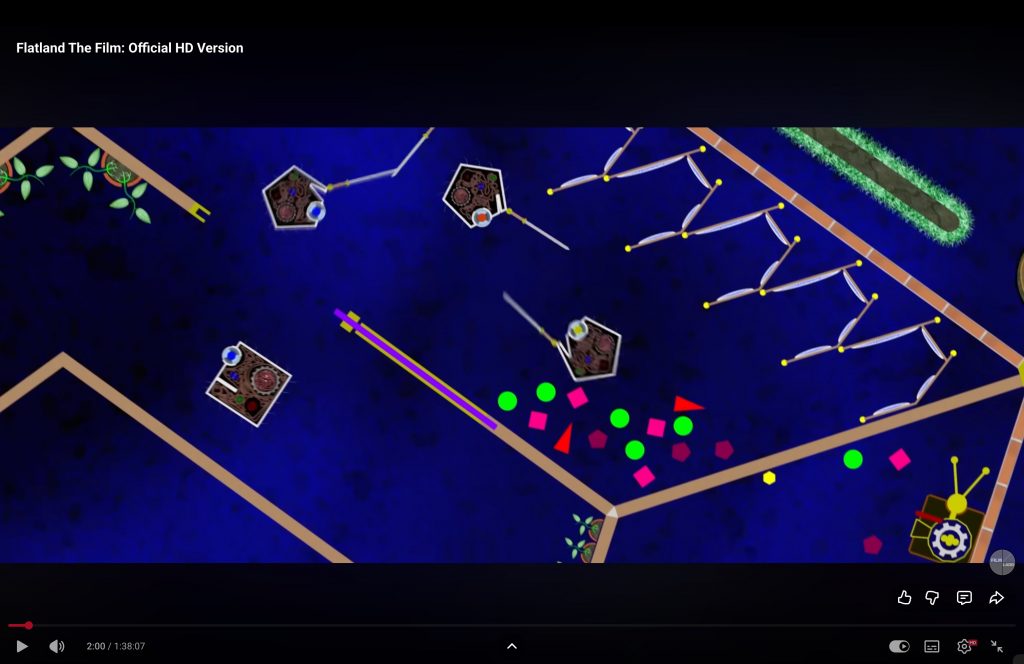
Based on this, I created a cat model in 3D software and sliced it into a single sheet along the sagittal direction. By adjusting different quantitative and variable parameters, I generated a series of two-dimensional images that had “completely lost their three-dimensional texture.” In this process, the depth information of the z-axis was projected onto the x and y axes and gradually weakened to a critical value. Although these images originated from three-dimensional space and displayed rotational motion within the software, visually they were perceived only as continuous variations of a single line. At that point, the sense of dimensionality completely vanished, leaving only a planar rhythm composed of motion trajectories.
Under such conditions, the boundary between three and two dimensions is compressed to its minimum. Even when the same dynamic image moves along the axis, it may still be perceived as purely planar and linear movement. This shifts the question toward the perceptual mechanism of the observer: does our sense of three-dimensionality truly arise from the object’s physical structure, or from our imaginative capacity toward the z-axis?
Experiment 2: Fragmented Reconstruction
In the second experiment, I again used a cat model as the subject and divided it into 29 equally wide fragments. I fixed the parameters of color, light angle, and fragment rotation direction, while changing the rotation speed, the spacing between fragments, and the camera angle as variable conditions. Under such experimental settings, the three-dimensional form of the cat was constantly reconstructed, sliced, displaced, and recombined.
This is both a three-dimensional operation within software and, simultaneously, a reproduction and deconstruction of a planar image. As the distance between fragments gradually increased, the object’s sense of volume collapsed—just like in the first experiment—leaving only two-dimensional motion composed of lines and fragments. The boundary of dimensionality continually shifted between fragmentation and recomposition, forming a visual suspension somewhere between “seeing” and “imagining.”
Losing Z seeks to reveal the perceptual conditions through which dimensionality is generated—it is not an inherent property of the model, but a result of collaboration between the viewer and the pixels. When more pixels are subdivided and participate with varying brightness and color, the sense of depth is reconstructed; conversely, when pixel information is simplified, compressed, or rearranged, depth gradually disappears, leaving only planar rotational movement.
This state of “losing the z-axis” is not merely the absence of depth, but a self-exposure of the visual mechanism itself—when we believe we are seeing the three-dimensional, we may in fact only be witnessing the expansion of the image’s own pixels.
Emerging Z
If Losing Z erases depth from vision, then its counterpart is the reappearance of depth—Emerging Z—not simply as a model, but as the sense of dimensionality constructed through shadows that we can perceive.
It stands opposite to Losing Z, yet is likewise built upon the trust between viewer and image. In the commercial realm, three-dimensional imagery carries a distinct aesthetic value and marketing presence. In advertisements, 3D-rendered graphics allow products to move, assemble, and transform according to their own personalities, constructing the “style” of the product and even the brand itself. Their anti-gravity motion and fluid disassembly animations provoke viewers’ desires for technology, speed, and perfection.
Take Dyson’s promotional imagery as an example—the rendered animations precisely calculate airflow trajectories, particle simulations, and light refraction, presenting a perfect, silent, and almost frictionless machine. Yet the actual working mechanism, the real assembly process, and the inevitable noise are all silenced within these flawless z-axis motions.

In such rendered images, the z-axis is infinitely expanded and projected onto the picture plane, constructing movements and spatialities that may have never existed in reality. Both Emerging Z and Losing Z focus not on whether an image originates from the real world, but instead on clarifying under what circumstances we are willing to believe in the reality of an image—and how that conviction in turn reshapes our ways of seeing and experiencing the world.
When we are captivated by perfect spaces and seamless motions, we are, in fact, participating in a design of trust: we choose to be persuaded by images, to believe in a world that has been simulated into being.
Reference
Manning, H.P., 1910. The Fourth Dimension Simply Explained. New York: Munn & Company.
Johnson, D. and Graham, J., 2007. Flatland: The Film of Many Dimensions. [film] Directed by Dano Johnson and Jefferson Graham. Austin, TX: Flatworld.
Dyson, n.d. Promotional visual of Dyson hair care product (gift edition campaign). [online image] Available at: https://www.dyson.de/haarpflege/alle-entdeckengeschenkedition [Accessed 20 May 2024].
Leave a Reply