>1_23
Draft
- P1
- For this project, my starting point was the paper model template.
- My intention was to remake this cat beginning from the unfolded paper layout.
- However, I want to be clear that I did not design the template from scratch.
- Instead, I worked with an existing paper model template and used it as a way to trace the process back into 3D, in order to understand how the form is constructed and translated.
- P2
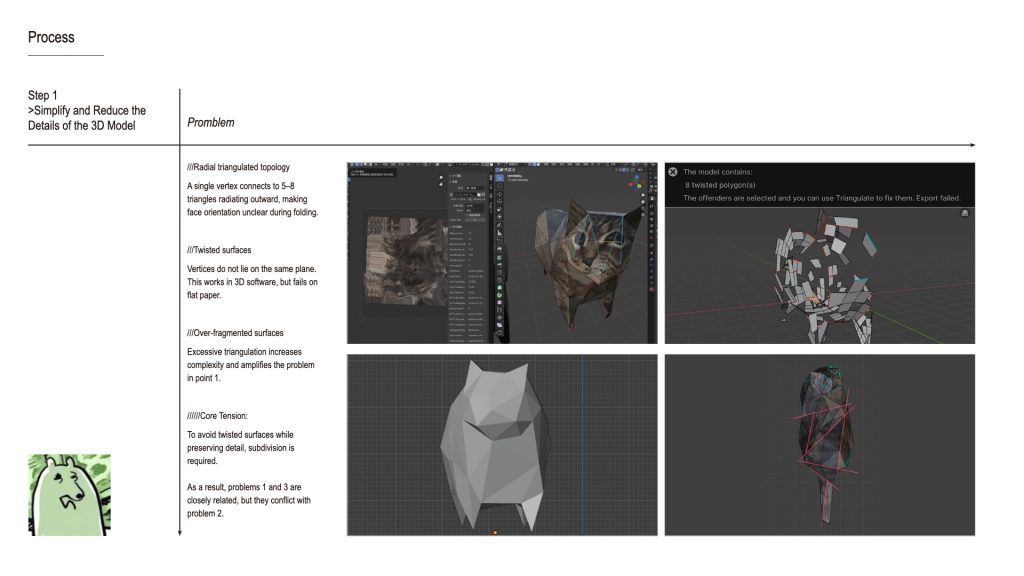
- The first step was simplifying a high-resolution model into a low-poly version suitable for a paper model.
- During this process, I encountered several problems.
- First, I relied heavily on triangulation to preserve detail.
- This works well in 3D software, but it fails when translated into paper, because it becomes unclear which direction the triangles should fold, and the UVs also start to distort.
- On the other hand, when I tried to merge triangles into larger faces, twisted surfaces appeared.
- These surfaces are acceptable in 3D space, but they cannot exist on flat paper.
- So at this stage, I was constantly negotiating a conflict between preserving detail and maintaining unfoldable geometry.
- P3
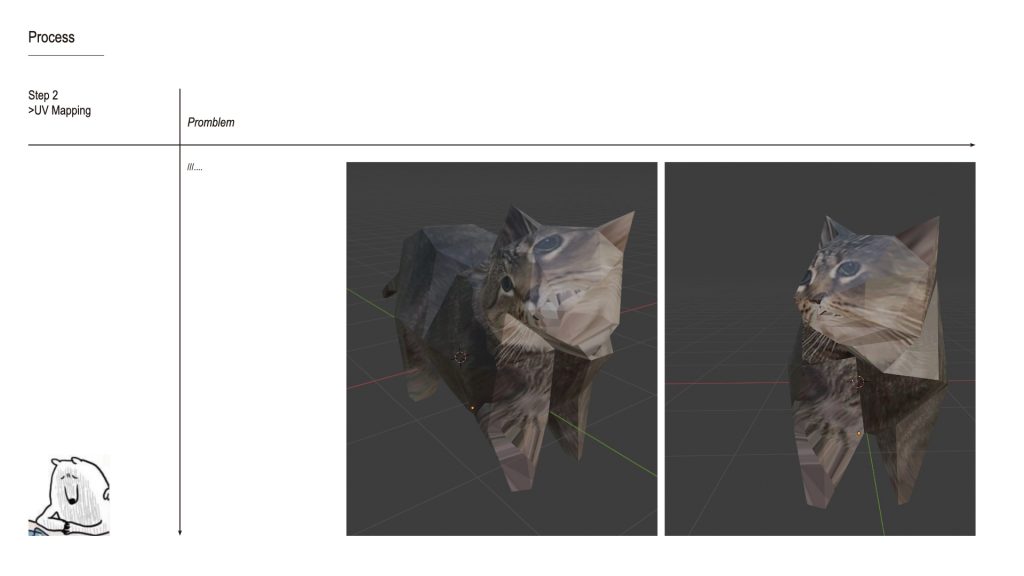
- The second step was UV mapping.
- At this stage, well…basically I admit that this mainly a technical issue
- P4
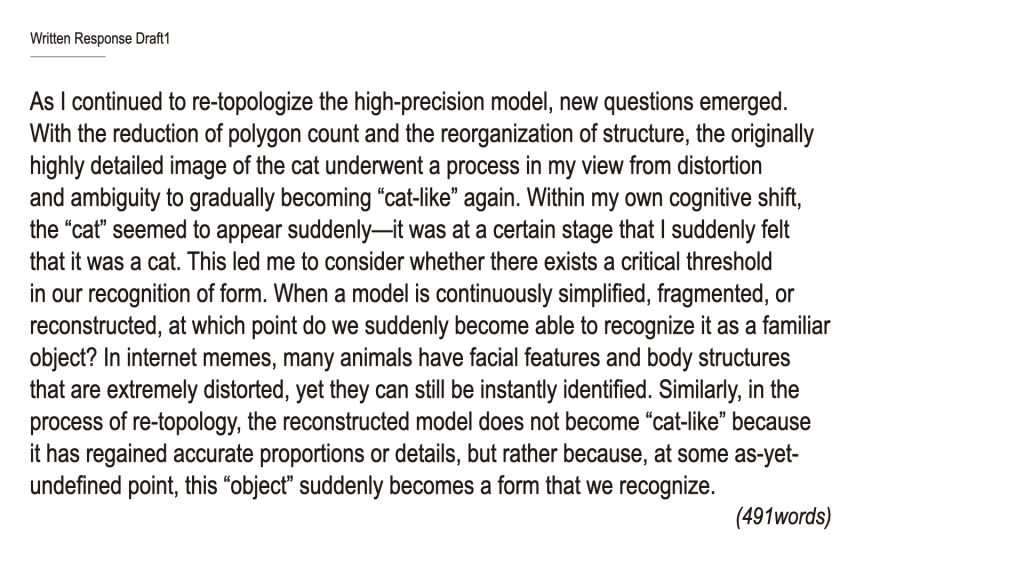
- Is there a threshold in our recognition of form?
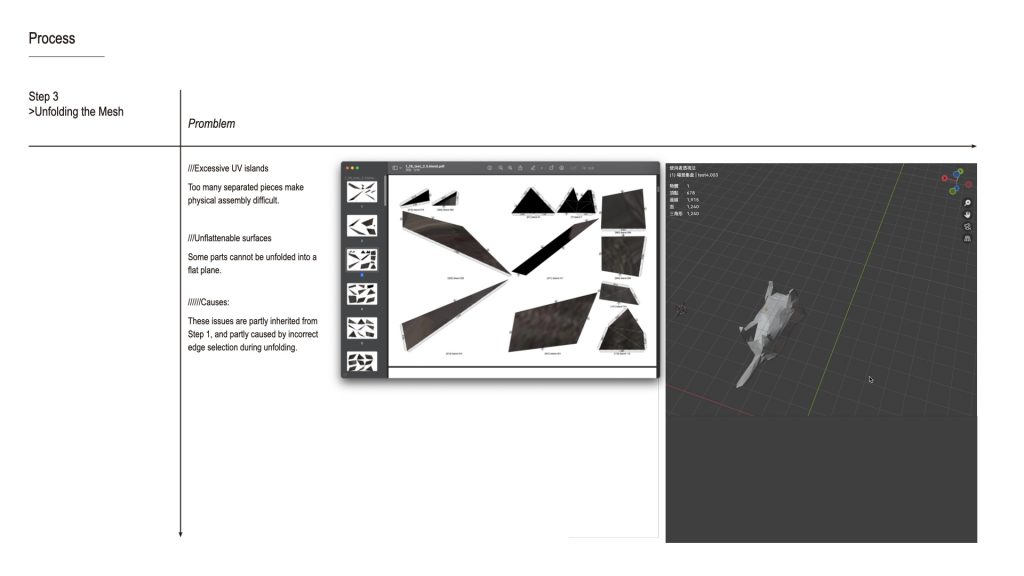
- The third step was unfolding the mesh into a paper template.
- Some of the problems here were inherited from the first step, which resulted in too many UV islands.
- But there was another issue as well: certain edge cuts made sense in a 3D view, but failed when translated into a flat, unfoldable plane.
- This made it clear to me that structures that appear valid in 3D do not necessarily translate into feasible 2D paper models.
- Video available
- P5
- Through this repeated process of errors and adjustments, technical problems gradually turned into conceptual questions.
- P6
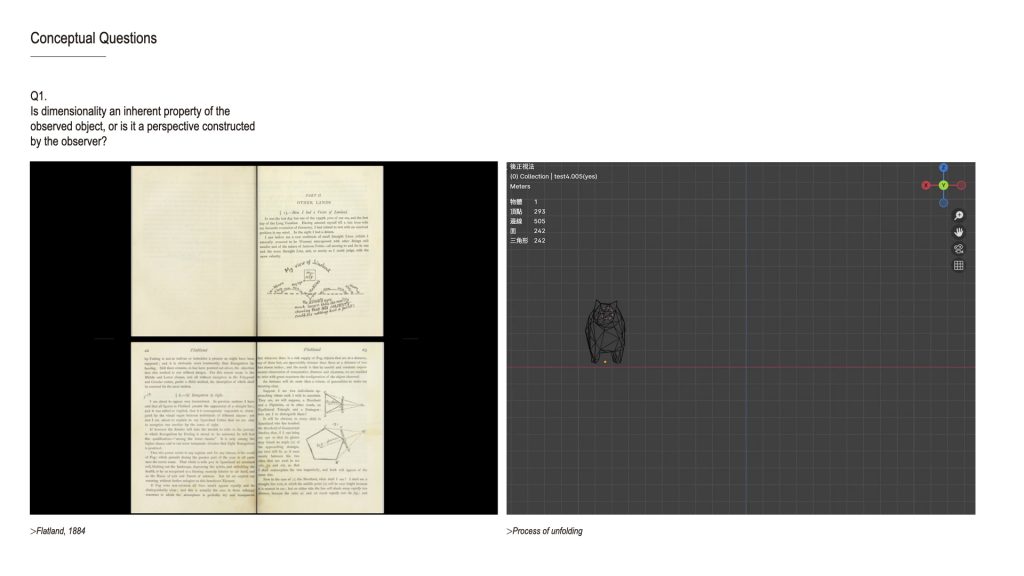
- The first question concerns dimensionality.
- When unfolding the model, I had to constrain my view to an orthographic projection in order to ensure a feasible paper template.
- Under this condition, surfaces collapse into projected edges, creating a viewing state that is almost one-dimensional.
- This reminded me of Flatland, and led me to ask:
- Is dimension an inherent property of an object, or is it constructed through the observer’s viewpoint?
- Video available
- P7
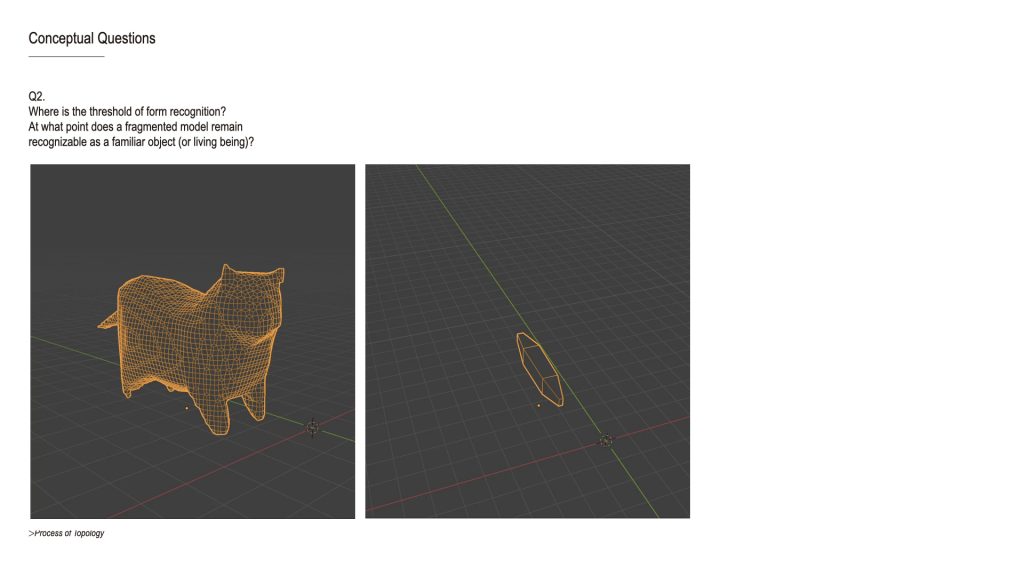
- The second question emerged during the re-topology process.
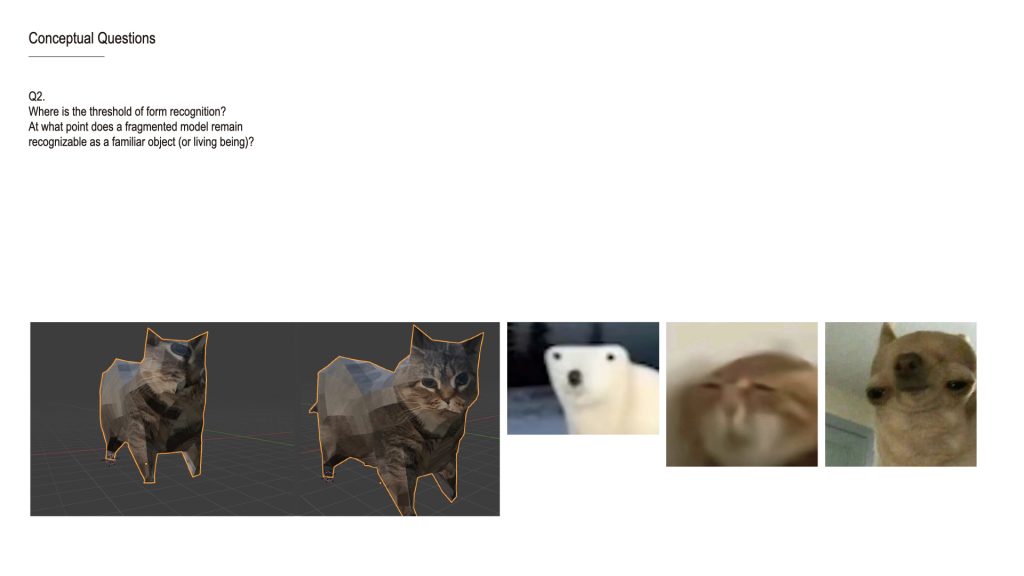
- As the model was simplified and reorganized, there was a specific moment when I suddenly recognized it as a cat again.
- Video available
- P8
- This made me wonder:
Is there a threshold in our recognition of form?
- This made me wonder:
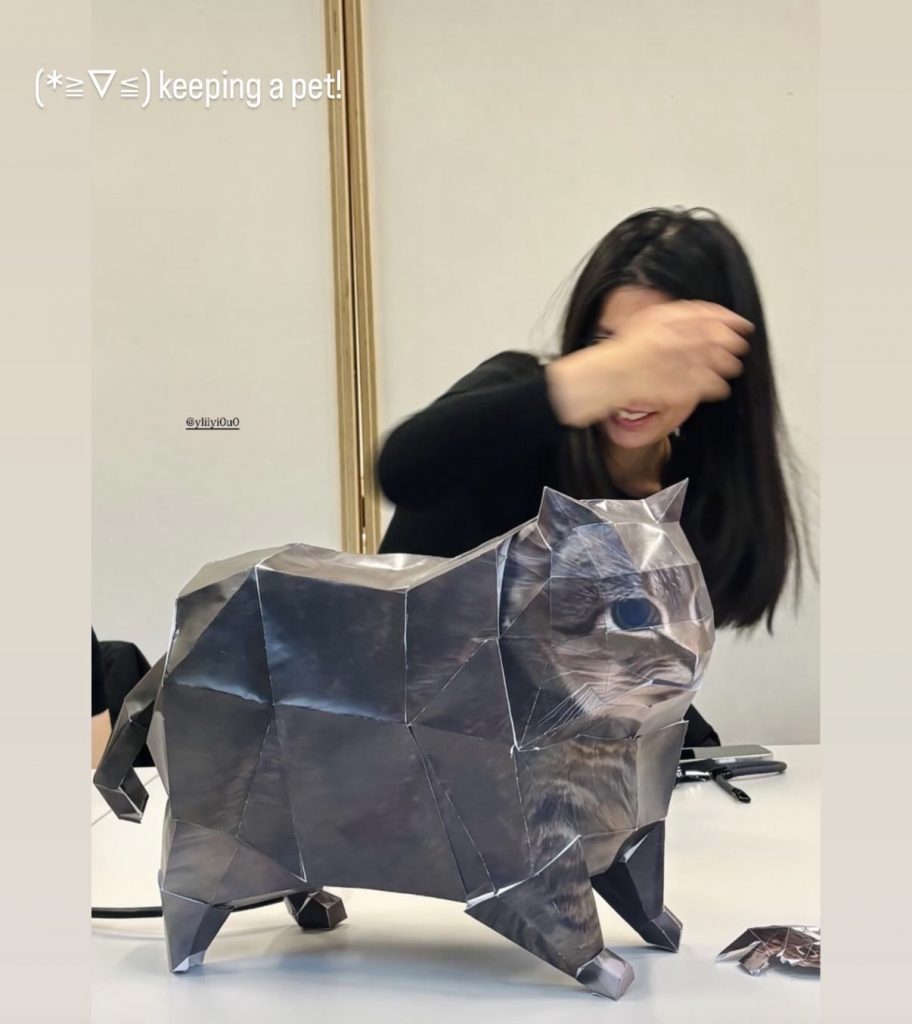
I eventually made a Cat by using pattern available online BTW…
Leave a Reply